I say it will. And I say that for three reasons:
- Large language models are capable of making many medical decisions. I’m not talking about some futuristic AI that hasn’t yet been developed – I’m talking about the technology that exists right now.
- The corporations that make AI have a financial incentive to replace physicians. Sure, there’s money to be made by AI solutions that make human doctors more efficient… and while some companies will make apps and market to doctors and hospitals and office managers, the real prize is to take doctors’ professional fees. Currently, these amount to ~1.5% of our entire GDP – an amount similar to the value of corn and soybean exports combined.
- The corporations that make AI have the political and financial means to achieve their objectives. They even have a ready-made political argument that will allow them to pull down the guardrails and bypass existing regulatory processes: there’s a physician shortage! After all, if the alternative to a computer doctor is no doctor, how good does the bot have to be?
To me, these three premises are as obvious as their conclusion is disturbing – and I still don’t understand how so many other people don’t see it.
–
Not long ago, I made a deeply unpopular highly controversial video laying out this argument and countering some of the common objections (but people like human doctors? what about liability? etc.).
Yes, Doctors: AI is Going to Replace You
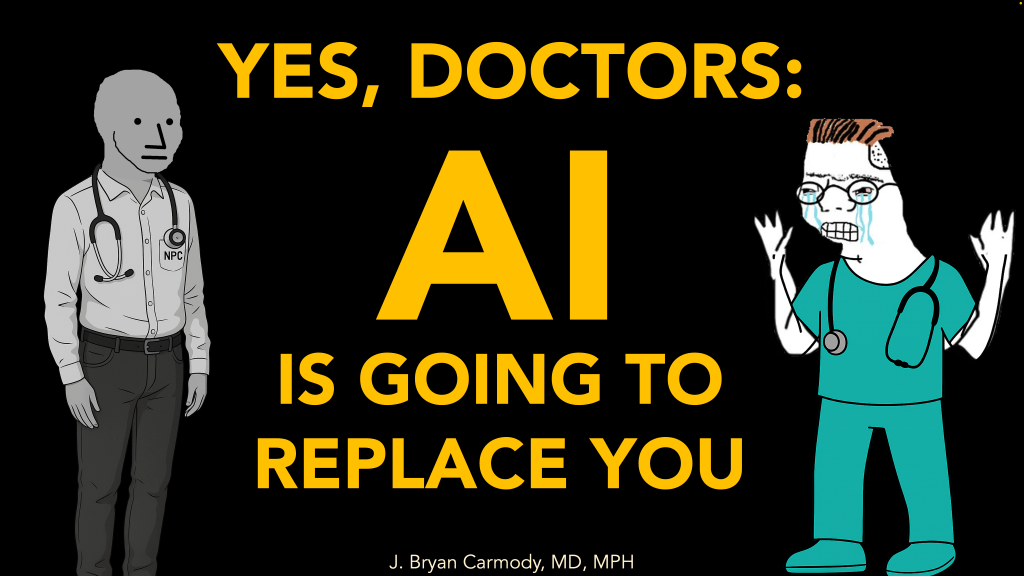
This video made people so angry generated such a vigorous discussion that I had to make a Part 2 to apologize, flesh out the argument in greater detail, and rebut even more objections.
PART 2: Yes, Doctors: AI is Going to Replace You
–
What I think really makes people so upset about this is not that I quoted Bill Gates or suggested that AI hallucination could be overcome – it’s the sense of hopelessness and inevitability that seriously analyzing this topic inspires. And for the record, I feel that, too. I’ve had numerous requests for a Part 3 focused on how physicians should counter AI replacement (from both an individual and a public policy point of view), and maybe I will – if only I can develop answers for myself.
–
ADDENDUM: Well, it didn’t even take an hour of publication here for these videos to reach more technologically-unaware doctors who firmly believe that a bot could never replace the important doctor work that they do. Funny thing is, the examples they gave as things that bots can’t do are actually things that bots can do – right now. Microsoft’s MAI-DxO already outperforms physicians on diagnostic reasoning (and at a fraction of the price), and autonomous surgery is actually not that far behind. (Honestly, the fact that so many physicians claim that I’m wrong before doing 5 seconds of Googling should probably be taken as further proof that our replacement with bots is inevitable.)
–
YOU MIGHT ALSO LIKE:
Tell Me Again About the Physician Shortage

 The Sheriff of Sodium