According to a new paper in JAMA Network Open, there is.
The authors used real rank order list data from the SFMatch to simulate what would have happened in the ophthalmology match from 2011-2021 if, instead of the tried-and-true, Gale-Shapley style deferred acceptance algorithm, a mixed-integer linear programming model had done the matchmaking.
The top line results are striking.
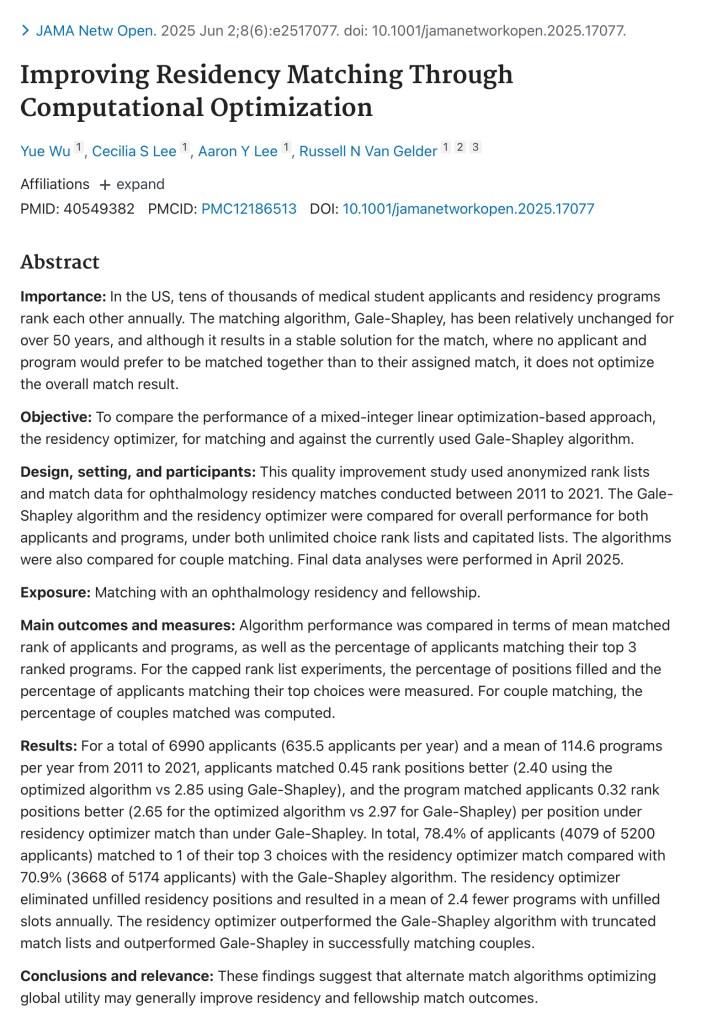
With the new algorithm, applicants matched 0.45 places higher on their rank order list, and 78.9% of applicants matched to one of their top 3 programs. Meanwhile, programs matched applicants that were 0.32 places higher on their rank order list, and zero programs went unfilled in any match year.
Sounds pretty good, right?
So can we just go ahead and change the resident match algorithm already?
–
Not so fast.
It’s been a while since I’ve given you a Journal Club™️… but after a well-publicized editorial in MedPage Today resulted in multiple readers asking me to comment, I realized one was due.
So give it a look… and if you don’t see the fatal flaws in this paper, give me a few minutes of your time and allow me to point them out.
_
YOU MIGHT ALSO LIKE:
Journal Club: Do USMLE Scores Really Predict Patient Care Outcomes?

 The Sheriff of Sodium