In March 2025, Yale’s internal medicine program director did something few other residency programs have done: he shared his ranking formula.
Several of you asked me to analyze it – but at the time, I had too much going to do it justice. But with some downtime around the holidays, I had a chance to work back on this… and once I dug into it, things got interesting.
So if you want the blueprint to match at an Ivy League residency program – or better yet, if you just want to see the perils and pitfalls in using formulae like this to rank applicants – come along with me for a deep dive into the Yale ranking algorithm.
(Running time 49:22)
–
A few teasers…
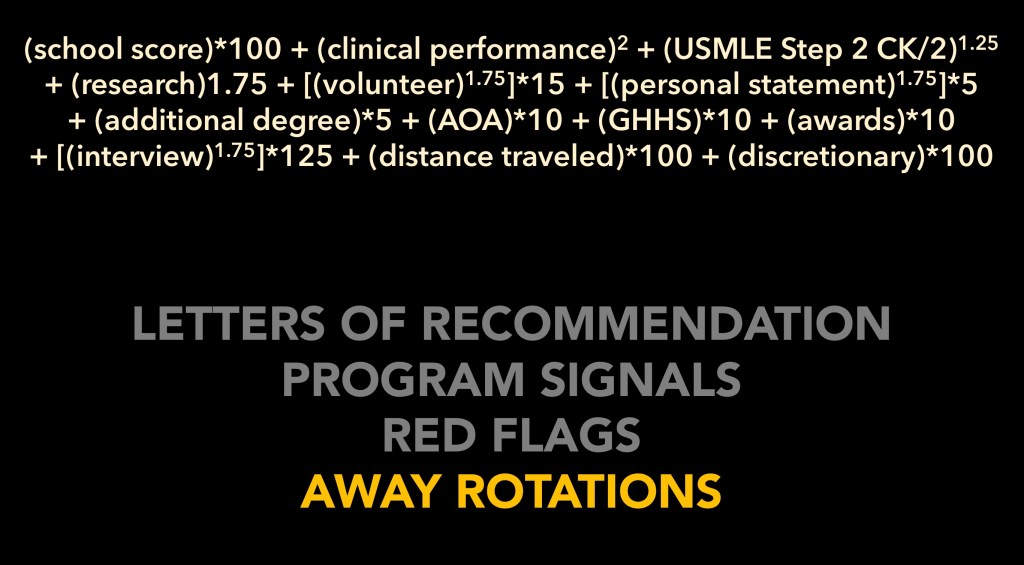
In a blog post, Yale’s program director shared both his ranking formula and a screenshot of the top of his rank list – thus providing a Rosetta stone to decipher what goes into ranking applicants at a highly selective program.
–
The first step is to work out what each variable represents.
–
There are some noteworthy omissions from the magic formula. (That doesn’t mean they’re unimportant – their impact is just upstream from ranking.)
–
Yale invites ~400 applicants to interview for their categorical residency positions. If you want to match at a highly-selective program and don’t signal, you’re wasting your money.
–
The fact that all of the coefficients are multiples of 5 shows that the ranking formula is not empirically derived, but reflects a value-based judgment about how much each variable should factor into ranking.
–
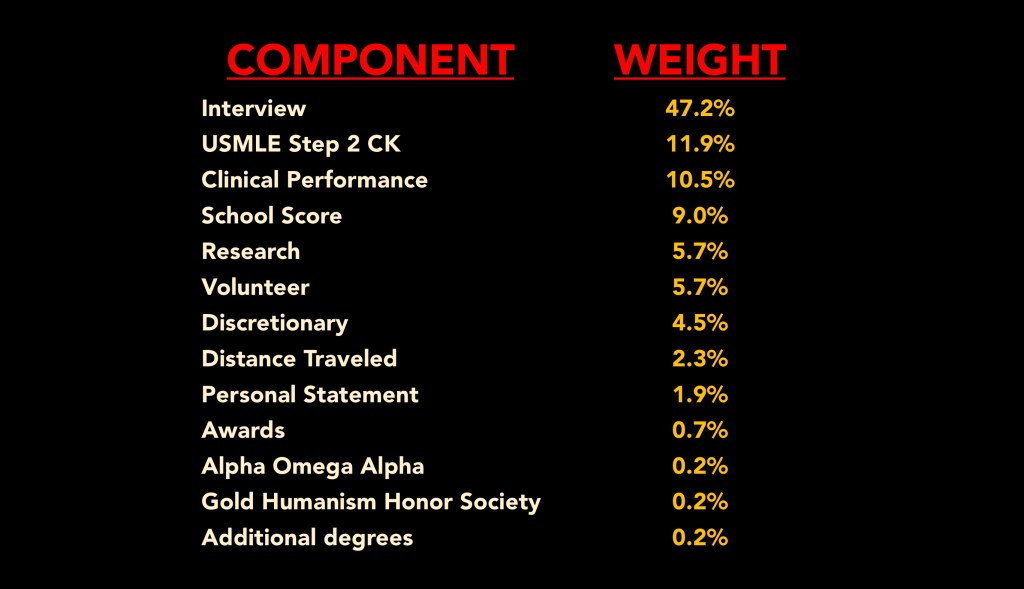
Nominally, the variable weights break down like this.
–
Distribution of USMLE Step 2 CK scores.
–
A variable’s real-world ability to influence ranking is driven not by its scale or coefficient, but by its variance. You may need a high USMLE Step 2 CK score to get in the door – but with the restricted USMLE score range among applicants who interview, Step 2 CK scores don’t move the needle much.
–
Exponents magnify differences on the higher end of the score range – which is fine if you truly believe that approximates the relationship between the variable and resident quality.
–
In ranking residents, the interview is king. But without a robust evaluation rubric, careful attention to interview structure, and consideration of inter-rater reliability issues, an applicant’s interview score may tell you more about their interviewer than about them.
–
How you measure variables matters. For instance, using a 4-point “school score” makes sense if you think that the quality of applicants varies like this. But in reality, there is likely more variation in applicant quality within a given school than from the mean of one quartile to the next.
–
ADDENDUM:
After the video started making the rounds on social media, Yale’s program director confirmed that my analyses were substantially correct. In particular, AWRD is awards other than AOA and Gold Humanism, and DISC does indeed represent discretionary points. But importantly, at Yale, interviewers receive the applicant’s full file – so their interview score is not an independent variable reflecting only their assessment of the applicant’s interpersonal qualities, but likely is heavily influenced by factors elsewhere in the application.









 The Sheriff of Sodium